
The fight against money laundering and terrorist financing (AML/CFT) is a major challenge for banking institutions. They must apply strict vigilance and reporting requirements in order to prevent the financial system from being used for criminal purposes.
It is often forgotten that, while bank accounts and electronic transactions are at the heart of this surveillance, bank safes, due to their secret nature, are also a major issue in the fight against financial crime.
Because the contents of a safe deposit box are not directly known to the person who keeps it, a safe deposit box can be used to store valuables whose origin or legal status may be suspect. It can also be used to store funds obtained through tax fraud and illegal activities. The attractive confidentiality offered by safe deposit boxes is often exploited by malicious actors to conceal assets and capital whose origin cannot be traced.
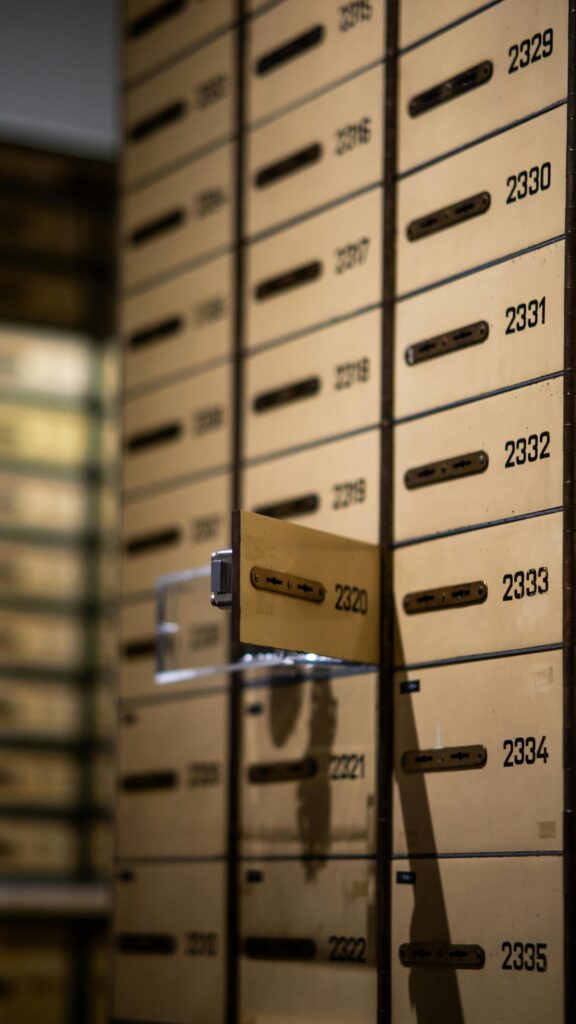
Banks therefore remain subject to a duty of care towards safe deposit box renters. Furthermore, they must be alert to certain warning signs, such as:
- The rental of a safe deposit box with no clear link to the customer’s stated needs;
- The use of a safe deposit box by a person with a high-risk profile;
- Analysis of the customer’s profile, consistency between the use of the safe deposit box and the declared situation;
- And even the monitoring of staff with access to safe deposit boxes…
It is easy to see that even if the safe deposit box is closed, vigilance is still required. Banks must apply the same rules of vigilance and reporting of suspicious activity to customers who hold safe deposit boxes as they do to other services, even if they are not aware of the contents.

This issue requires monitoring not only the safe deposit box, but also the customer, and above all the context. In Belgium, for example, the Law on various provisions relating to the economy, published in the Belgian Official Gazette on 21 March 2024, extended the scope of the anti-money laundering law to non-financial organisations (hotels, warehouses, etc.). It should be noted that prior to this law, anti-money laundering obligations only applied to financial institutions offering safe deposit box rental services.
In conclusion, even if the contents of a bank safe deposit box are beyond the direct control of the institution, it cannot be said that the rental of a safe deposit box is a blind spot in the fight against money laundering and terrorist financing. Due diligence obligations apply to both the customer and the rental service. The prevention of money laundering and terrorist financing therefore does not stop at the door of the safe deposit box: it requires an analysis of the overall risk and the ability to detect atypical uses (KYC, risk assessment, monitoring).